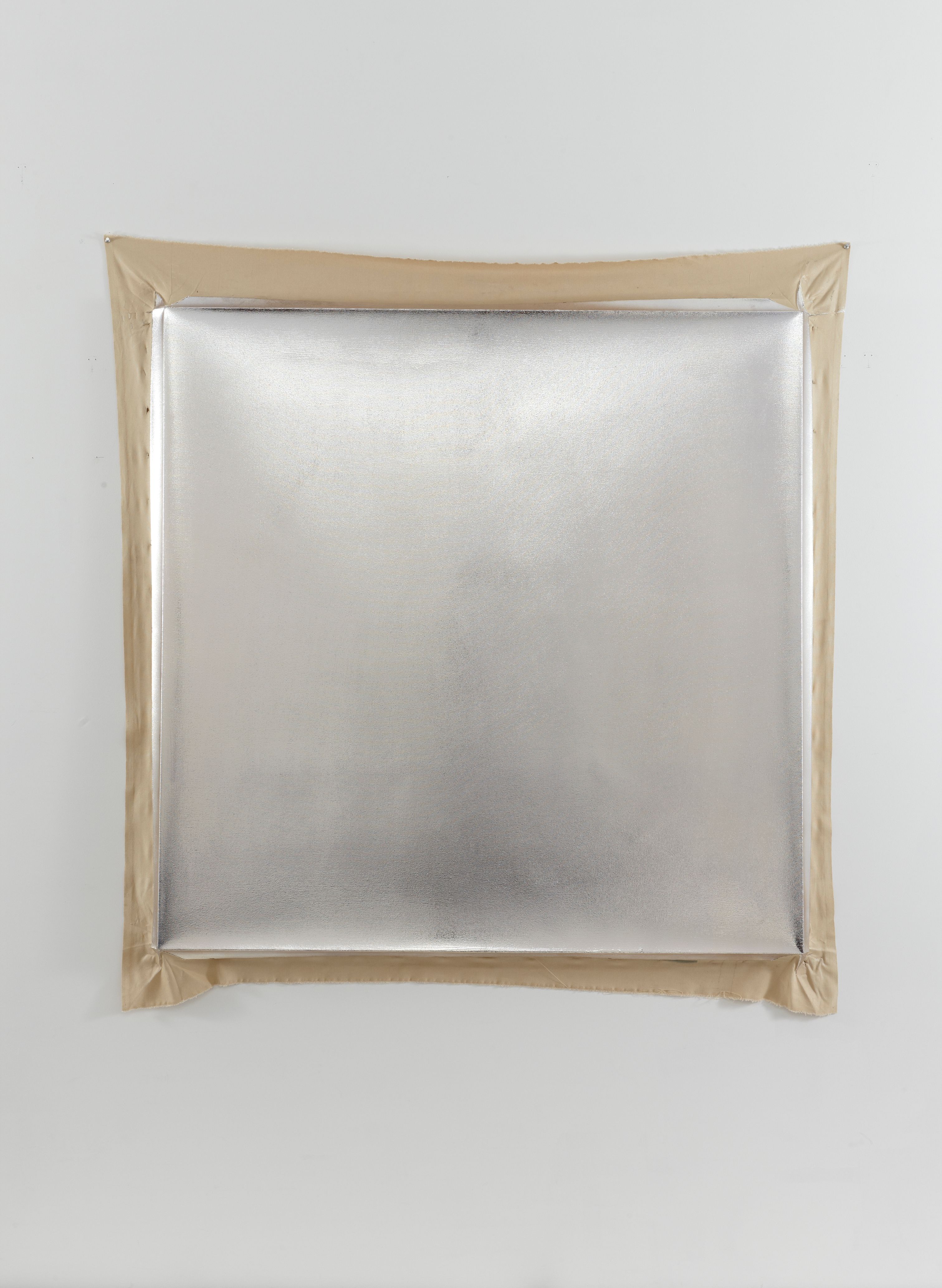
The project consists of ten works, some installed on the wall, others placed on the ground. The canvases are presented as reflective panels that welcome phantasmic presences of the underlying painting and at the same time absorb and restore the external space to the work. The canvases on the ground, sculptural elements, are conceived as rejects: scraps that rise to the value of possibility / potential. Kassay's work is anchored to a minimalist praxis in which the industrial process in the production of the work subtracts the quality value of the artefact to replace it with that of objectivity, making it in a certain sense interchangeable. The conceptual elements of monochromatism, of the objectification of the pictorial pigment, of the reflection of color, movement and form, assume centrality in his research and are codified and translated into a new metaphysics of the pictorial surface, in a new form of abstraction, strongly lyrical, where the reference to photography is evident. The realization of his works starts from the preparation of the canvas with the drafting of large fields of acrylic that make the surface waterproof, to then move on to the subsequent silver plating, chemically obtained with an industrial process similar to the electroplating bath that crystallizes the accidents of the painting on the canvas, causing unevenness of the silver surface. The plating process also determines a combustion / burning of the edges and exposed parts of the canvas along the perimeter, and the appearance of unevenly burnished and oxidized areas on the metal surface that Kassay cannot preventively control. Kassay, trained in photography, has transposed many of these techniques into painting practice. The chemical process of silvering the canvases is similar to the ancient process of photography on gelatin with silver salts: both techniques produce a transmutation in which light becomes the central element for raising awareness of the support and perception of the work.