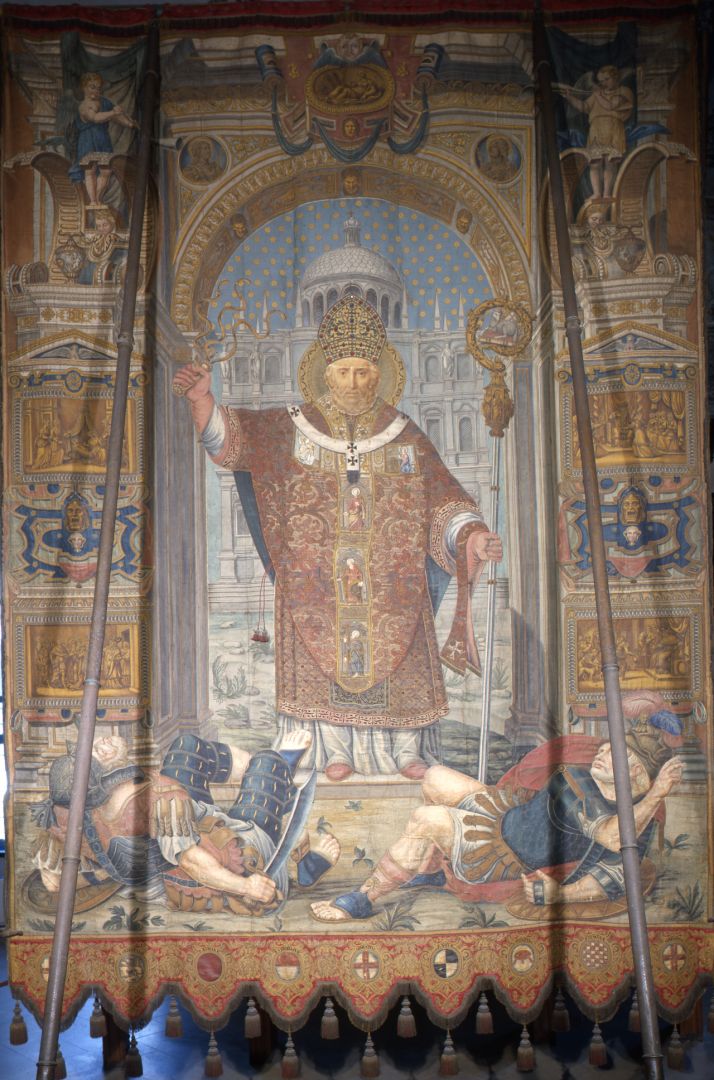
Executed based on the design of Giuseppe Arcimboldi and Giuseppe Meda, the gonfalon was made with embroidery and tempera with precious inserts by the embroiderers Scipione Delfinone and Camillo da Posterla. The work, 5 meters high and 3.50 meters wide, was commissioned by the Magnificent Community of Milan in 1565 and completed in 1566. On September 8 of that year, in fact, the Gonfalon was shown to the citizens and blessed by Archbishop Carlo Borromeo. From iconographic testimonies, we know that it remained in use until the end of the nineteenth century. On both faces, Saint Ambrose appears, the patron saint of Milan. He holds the staff in his right hand, his traditional attribute alluding to the expulsion of the Arians, and in his left hand a very elaborate pastoral staff, symbol of his episcopal role. Ambrose's sumptuous robes are adorned with panels depicting scenes of the Annunciation and the Saints Peter, Paul, and Barnabas, figures that reappear in the knot of the pastoral staff in the form of a small temple. The mitre has inserts of polychrome precious stones. The patron saint of Milan is framed by a round arch, while behind him a building is adorned with scenes depicting stories of his life. The complexity of the figuration and the richness of the materials make this work an extraordinary testimony of a highly refined art.