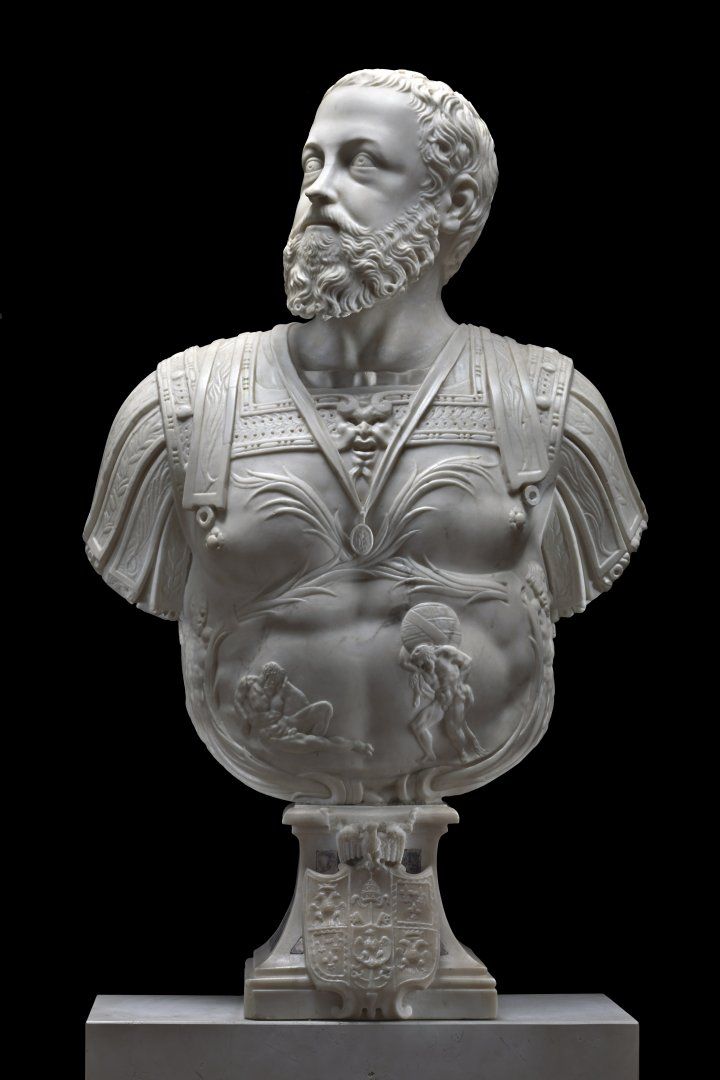
The bust was made by Prospero Sogari Spani, known as Clemente (Reggio Emilia, 1516-1584), commissioned by Duke Ercole II d'Este (1508-1559) who, at the suggestion of his brother Cardinal Ippolito, had chosen as his emblem the representation of Patience, to whom he had dedicated a dressing room in the Estense Castle of Ferrara, decorated in turn by a painting by Camillo Filippi with the same allegory and also by this bust. Worthy of note is the decorated armor which represents Pazienza as a tied woman waiting to break free thanks to the drops of water that fall from a jug on the chain to which she is tied. The elegant and delicate profile of the portrayed, as well as the abundance of details and preciousness that cover not only the bust but also the base, are an example of that sophisticated language that characterizes the Emilian mannerism, which saw leading exponents in personality such as Parmigianino (1503-1540), Girolamo Mazzola Bedoli (1500-1569), Lelio Orsi (1511-1587), Nicolò dell'Abate (1512-1571) and Francesco Primaticcio (1504-1570).