
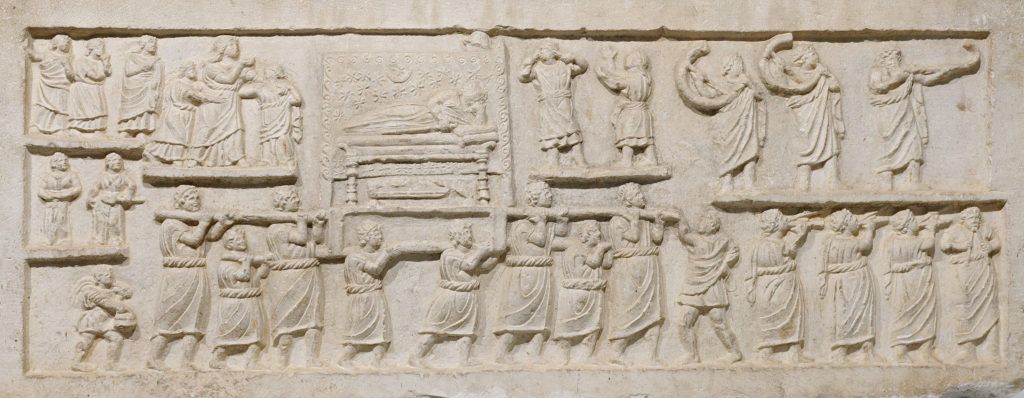
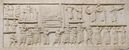
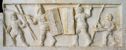
The relief found in Amiternum is certainly one of the most important testimonies relating to the carrying out of a funeral ceremony. The sculptural apparatus represents a funeral procession scene organized on two compositional registers which, in reality, have the purpose of giving depth and three-dimensionality to the representation. The characters present on the stone slab are numerous, but identifiable in their tasks: starting from the left, at the top, the praeficae are visible, women specially paid to artfully demonstrate the pain, singing songs in honor of the deceased; on the lower level there are eight men (lecticarii) who support the coffin, anticipated by the dissignator, who directs the ceremony; on the right the flute players (tibicines) are recognizable, while above the horn players (cornicines), preceded by a trumpeter (tubicen). In the central position the deceased is depicted, placed on a funeral bed: the position, unnatural for a dead person, of the elbow bent on the pillows suggests that it was an actor who played the role of the missing character. The exsequiae, that is funeral honors, originally took place at night, to safeguard the integrity of priests or magistrates as the mere sight of the deceased's body caused impurity. The relief can be considered a work of local folk art and it is possible to date it between the end of the 1st century BC. and the beginning of the following century.